Run a Marketing Performance Meeting That Ends With a Plan
Your marketing performance meeting should end with a decision, an owner, and a way to check what happens next. If most of the meeting goes into reconciling numbers, the team has less time to work through the problem.
Recently, I brought Google Analytics 4, Google Search Console, Google Business Profile, and Nightwatch rank tracking into one reporting system for a client. The work addressed a familiar problem: jumping between reports and trying to reconcile different filters while the conversation was happening.
Bringing the information together gives the team a place to investigate performance. The next step is using that information to decide what to do.
Start with a question the team can act on
“Organic traffic is down” gives you something to notice.
“Which pages need attention, and what should I investigate first?” gives the meeting a direction.
Before building a report, I want to understand that decision. It should guide what appears first, which comparisons are available, and where someone can look for more detail.
Work through the change together
Here’s an illustrative example, separate from the client project.
Imagine a team reviewing a decline in organic website traffic. The drop is concentrated on a service page. Search Console shows fewer clicks while impressions are roughly unchanged. Compare the same page across equal periods before investigating the relevant queries and devices.
In the example below, impressions stay at 10,000 while clicks fall from 400 to 300. Click-through rate falls from 4% to 3%. Look at the gap between appearing in search and earning the visit.
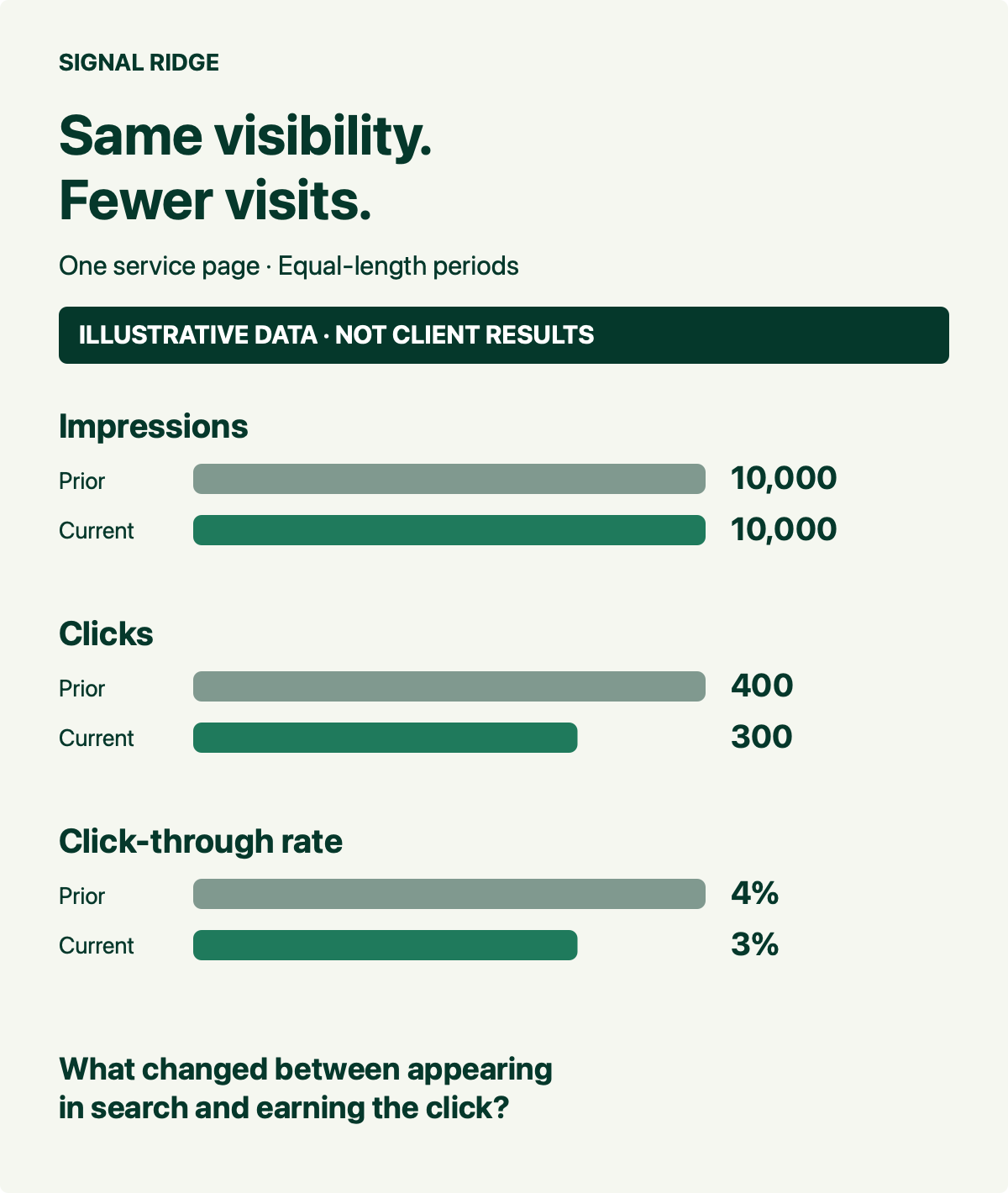
Illustrative data, not client results. Fewer clicks with similar impressions gives the team a focused question to investigate; it does not establish the cause.
It’s a reason to inspect the queries, devices, and search results associated with that page. The team can also review recent page changes. A ranking view may add context where it covers the relevant searches.
Now someone in the meeting can contribute what they know. Perhaps the page was recently edited. Perhaps the customer questions have changed. Those are possibilities to check against the evidence.
I want the reporting to make that conversation easier while the people who understand the work are together.
Leave with an action and a way to check it
Write the next step down before moving on. Give it one owner and a follow-up point.
For the illustrative example above, a meeting record could look like this.
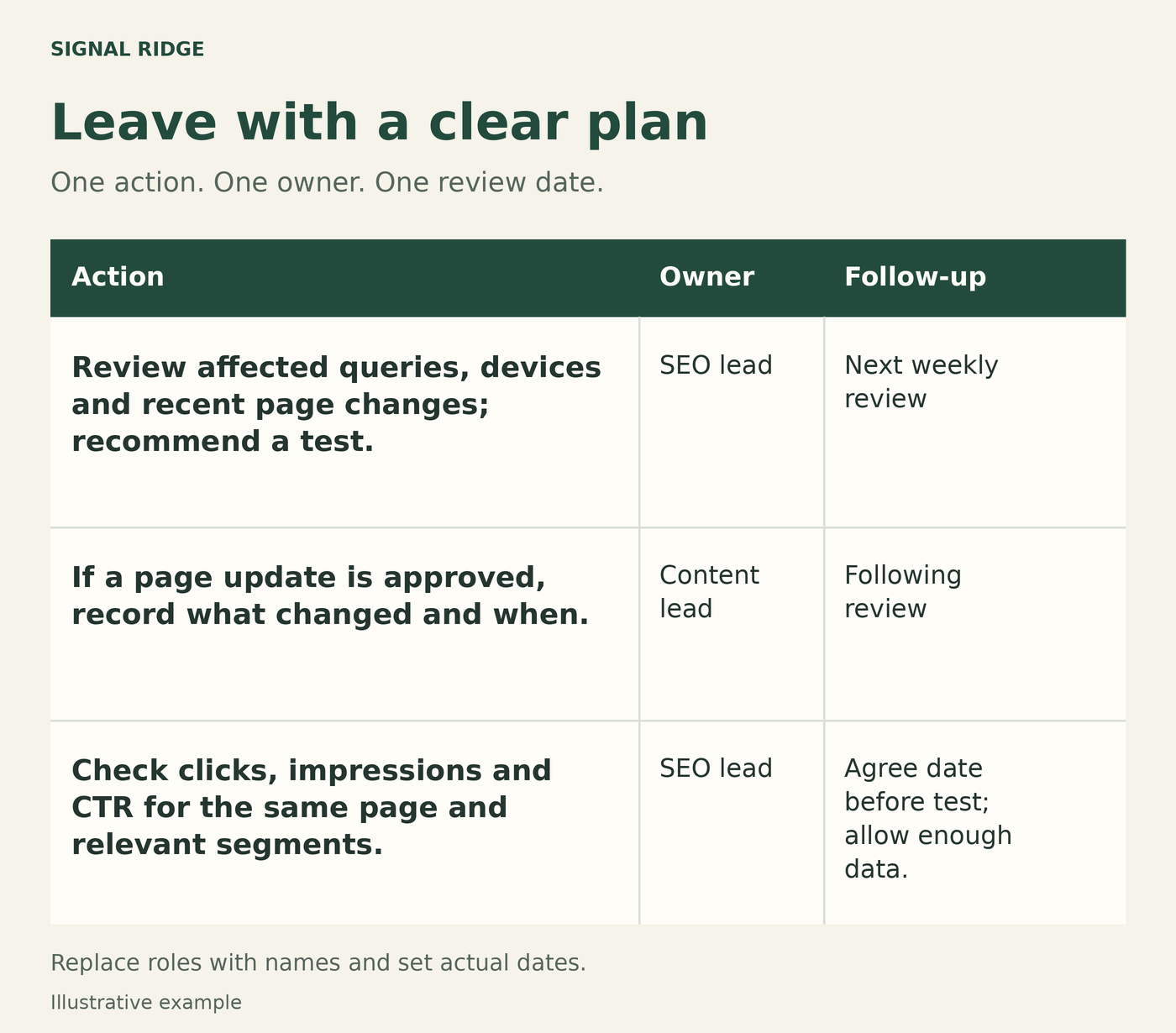
Illustrative example. Replace roles with names and set actual dates. Agree on the comparison before launching a test, and allow enough data to assess it.
Use this before you end the meeting
Copy this record and fill it in before moving on:
Decision or investigation: ___
Evidence: Page, audience or channel ___; comparison ___
Owner: ___
Follow-up date: ___
Check: Continue if ___; change if ___; stop if ___
That gives the next meeting somewhere useful to start.
My goal: 2x meeting productivity
I’m developing a pilot with a goal of doubling the productivity of marketing performance meetings.
I want to test it by tracking time spent assembling and reconciling numbers, time spent investigating performance, and whether decisions leave the meeting with clear ownership and follow-up.
I want to enable the great problem solver inside of you!
If your team has useful marketing data spread across several tools, I’d like to help connect it around the decisions you need to make. The pilot is for teams whose performance meetings spend too much time reconciling reports and too little time deciding what to do.
I’m offering the next two pilot clients 50% off. Bring your current report and one decision you want it to help you make. We’ll talk through the reporting, the decision and whether the pilot fits.