Marketing Teams Don’t Have a Reporting Problem. They Have a Decision Problem.
Most marketing teams already have plenty of reporting. That’s usually not the problem. The problem is whether anyone can actually use that reporting to make a decision with confidence.
I saw this pretty clearly on a project with a company managing 23 different brands.
Their paid media team had hundreds of spreadsheets. The people using them were capable. They knew Excel. They understood the business. They were doing what they could to get the answers they needed.
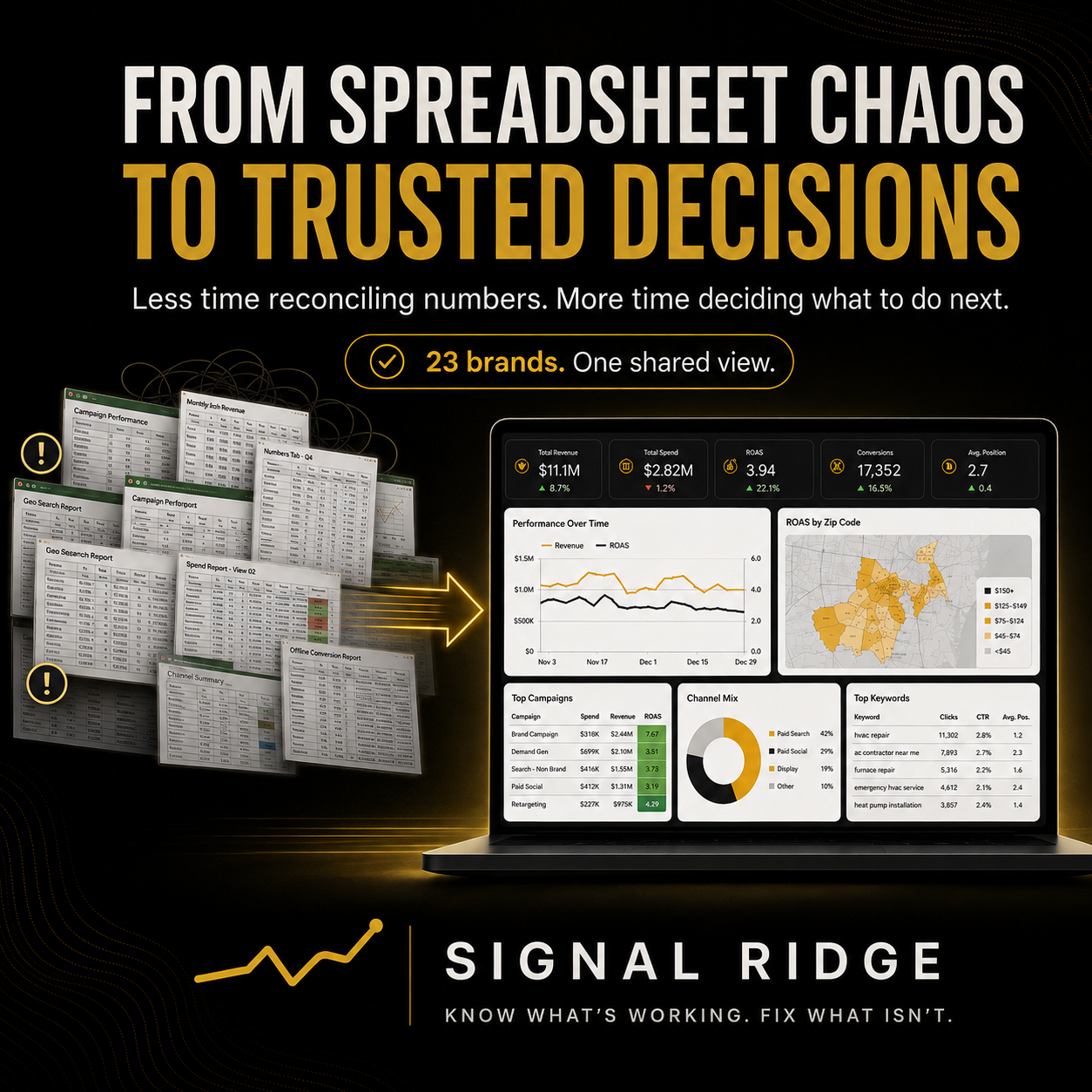
What bothered me was how hard it was to track a number down. You’d open someone else’s spreadsheet and have to figure out where the number came from, what formula was being used, whether something had been hard-coded, and whether everyone was even looking at the same version of the truth.
That might sound like a reporting problem. But the real cost showed up in meetings.
Someone would hear a number, tune out of the conversation, go dig through their own spreadsheet, and come back a few minutes later with an answer.
Meanwhile, the actual discussion had moved on.
That’s the point where reporting stops being useful. The people weren’t the problem. They were good at what they did.
The system just wasn’t making it easy for everyone to work from the same information.
Good reporting should reduce the need to investigate the report.
A useful reporting system should let you start with the high-level question and work your way into the details without leaving the system.
If performance is down, you should be able to ask why. If one market is outperforming another, you should be able to drill into it.
If ROAS looks strong overall, you should be able to see whether that strength is concentrated in a few campaigns, locations, or ZIP codes. You shouldn’t have to leave the meeting, open another spreadsheet, find the right tab, inspect a formula, and then explain how you got there.
That’s what we worked toward in this project. We built a consolidated reporting system across all 23 brands so the team could move from a portfolio-level view into the details, including ROAS by ZIP code.
The goal wasn’t simply to put more numbers in one place. It was to make the system easier to trust, easier to navigate, and easier to use when someone needed to decide where to double down and where to back off.
The same problem shows up in different ways. I’ve seen this in other businesses too. Sometimes the data exists, but reporting isn’t standardized, so every client or team sees a different version of the story.
Sometimes every manager has their own way of tracking spend, but nobody has a consistent way to compare performance against budget or prior periods.
Sometimes the systems themselves are all technically “right,” but no one has connected them well enough to answer the business question. Google Ads might show one campaign producing the cheapest conversions while the CRM shows another producing the better customers. Until those answers are connected, cheaper isn't necessarily better.
That’s why I’ve become much less interested in dashboards for the sake of dashboards.
The better question is: What decision are we trying to make, and does the reporting make that decision easier?
If the answer is no, the reporting probably isn’t finished.
Test your own marketing reporting
Pick a real decision your team made recently — moving budget, cutting a campaign, increasing spend, or changing where you’re investing.
Then ask:
What changed?
Why did it change?
Can we trace the number back to its source?
Can we drill into the cause without opening another report or spreadsheet?
Do we know whether the marketing result ultimately produced better leads, customers, or revenue?
If answering those questions means opening three platforms, asking someone to check a spreadsheet, or debating which number is right, that’s the gap.It’s a short diagnostic designed to show you where your marketing decision system is breaking down—and what I’d fix first.
Take the Marketing Decision Assessment:
https://signalridgeinsights.com/marketing-decision-assessment
Know what’s working. Fix what isn’t.